.webp)
The Architectural Evolution of Kingdom Rush: How Level Geometry, Pathing Mechanics, and Spatial Economy Defined the Tower Defense Genre
When Ironhide Game Studio launched the original Kingdom Rush in 2011, the tower defense genre was heavily dominated by grid-based spatial systems like Desktop Tower Defense or open-field maze builders like Bloons Tower Defense. Kingdom Rush departed from these paradigms by establishing a fixed-pathway framework defined by tactical chokepoints, static build spots (nodes), and real-time physical interaction via micro-managed dynamic units. Rather than allowing players to construct artificial mazes, the game transformed level geometry itself into the primary strategic puzzle. The design mechanics of Kingdom Rush rely on space, pathing loops, node placement, and spatial economy, forming an intricate mechanical ecosystem that matured across its core titles—from the classic Kingdom Rush to Frontiers, Origins, and Vengeance.
Understanding Kingdom Rush beyond surface-level aesthetics requires examining the structural design of its battlefields. Every map in the franchise functions as a closed spatial system where enemy speed, path length, tower range radii, and dynamic blocking zones intersect. By examining how track geometry dictates DPS efficiency, how enemy movement vectors exploit spatial design, and how build spots govern resource distribution, one uncovers the precise mechanical architecture that elevates the franchise. This article provides a comprehensive academic analysis of the spatial and structural engineering behind the level design of the Kingdom Rush series.
1. Static Node Topology: The Structural Mechanics of Fixed Build Spots
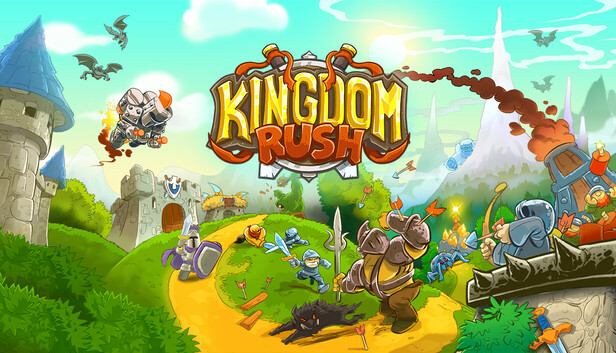
The foundational design choice of the Kingdom Rush series is the complete rejection of open-grid placement in favor of fixed node topology. In grid-based tower defense games, players manipulate enemy pathing directly through wall construction or mazes. In Kingdom Rush, the enemy pathing is completely deterministic and predefined by the level geometry. Players are instead constrained to discrete, pre-selected construction nodes distributed along the edges of the path. This structural constraint fundamentally shifts the mechanical challenge from spatial creation to spatial optimization.
Node placement determines a tower's operational coverage area, which is calculated as the intersection between a tower’s circular targeting range and the path polyline. Because nodes are fixed, each build spot possesses a constant potential coverage time—the precise duration an enemy traveling at a constant velocity remains within that node's attack radius. High-value nodes are situated where the circular radius intersects multiple segments of a path (such as a hairpin bend or a parallel loop), effectively multiplying the tower's operational uptime without increasing its statistical range.
Furthermore, fixed node topology enforces a strict spatial economy. Because the number of nodes per level is strictly limited, money (Gold) is not the sole limiting resource; structural real estate acts as a secondary, equally vital currency. A player cannot simply spam low-cost towers to compensate for poor positioning. The spatial ceiling of a map forces players to evaluate DPS per square unit of coverage, requiring structural upgrades to maximize output from a finite set of strategic positions.
2. Path Geometry: Curves, Loops, and the Mechanics of Effective Range
Path geometry in Kingdom Rush acts as the primary vector for controlling difficulty and DPS efficiency. Level designers utilize several distinct geometric configurations—straight lines, soft curves, hairpin turnarounds, and concentric loops—to alter the effective power of player defenses. A straight path segment offers the lowest efficiency for circular targeting ranges, as a straight line passing through a circle creates a minimal path distance inside the target area.
Conversely, hairpin turns and tight loops maximize the length of the path segment contained within a single tower's range radius. When a path curves around a node, the linear path expands into an arc, increasing the time an enemy spends inside the killing zone. The relationship between enemy velocity, tower attack range, and path geometry governs the potential total damage delivered by a tower over time.
By varying the path curve radius throughout a map, designers create specialized zones tailored to specific tower archetypes. Outer bends favour long-range, low-firing-rate towers such as the Artillery (Bombard) or Archmage, which benefit from prolonged target acquisition windows. Inner curves, where path segments converge tightly, favor high-rate-of-fire single-target towers or area-of-effect (AoE) structures that hit dense clusters of units traversing the vertex.
3. Vector Intersection and the Spatial Mechanics of Chokepoints
The core tactical feature of any Kingdom Rush map is the chokepoint—a structural nexus where spatial geometry, unit collision, and range overlaps align. A true chokepoint is not merely a narrow path section; it is a vector intersection where player-controlled blocking forces halt enemy momentum directly inside the overlapping attack perimeters of multiple offensive towers.
The creation of a functioning chokepoint requires three structural components working in spatial synchronization:
The Anchor Component
The static physical point provided by Barracks troops or summoned Hero units that halts enemy movement. The spatial positioning of this rally point dictates where the enemy cluster will form.
The Multi-Sector Fire Envelope
The area surrounding the anchor point that falls within the overlapping coverage radii of at least two to four adjacent tower nodes.
The Path Confluence Zone
Locations where two distinct enemy paths merge into a single lane, or where a single lane bends sharply back on itself, doubling the density of incoming wave vectors.
When an enemy unit is blocked by a Barracks unit, its velocity drops to zero, rendering standard traversal duration irrelevant. In this state, the duration of exposure within the fire envelope becomes a function of the Barracks units' structural health and armor ratings rather than the enemy's natural movement speed. Effective spatial management relies on engineering these high-density kill zones where splash damage weapons (Artillery/Mage towers) deal maximum damage across stacked enemy hitboxes.
4. Micro-spatial Interventions: Barracks Rally Points and Dynamic Stalling
Unlike conventional static tower defense systems, Kingdom Rush incorporates dynamic micro-spatial mechanics through the Barracks tower and Hero unit systems. Barracks do not shoot; instead, they deploy foot soldiers who move along a defined operational radius to physically engage enemies on the path. This operational radius introduces dynamic spatial manipulation to an otherwise rigid, static map architecture.
The ability to freely adjust the Barracks "Rally Point" within a circular boundary around the tower node allows players to artificially alter the location of the engagement zone. This mechanics provides two crucial spatial tactical functions:
1. Upstream Stalling
Shifting the engagement zone forward along the path to intercept fast-moving target vectors before they reach vulnerable structural assets or secondary lanes.
2. Dynamic Chokepoint Alignment
Moving soldiers backward or sideways to pull blocking combat directly into the optimal damage intersection of high-tier damage towers.
Furthermore, Barracks soldiers introduce physical collision volumes (hitboxes) to the path. When enemies encounter soldiers, they enter a locked melee state, forming a static cluster. This clustering compresses enemy density. The geometric shape of this cluster is determined by the number of soldiers, their collision radii, and the path width. By placing rally points strategically, players manipulate not just where enemies stop, but how tightly they bunch up, directly increasing the damage efficiency of surrounding splash-damage towers.
5. Dual-Lane Dynamics: The Spatial Multi-Threaded Puzzle
As the Kingdom Rush franchise evolved from the original game into Frontiers and Origins, level design moved away from single-track layouts toward complex, dual-lane and multi-threaded path architectures. Dual-lane maps split enemy flow into distinct streams, forcing players to divide their finite Gold and node real estate across multiple operational fronts.
Multi-threaded path designs introduce complex spatial trade-offs. Designers structure these maps using one of three primary topologies:
Parallel Paths
Two distinct tracks run side-by-side, allowing central build nodes to attack enemies on both paths simultaneously, maximizing structural real estate efficiency.
Converging Paths
Two separate spawn points channel enemies down distinct routes that merge into a single trunk line before reaching the exit, encouraging players to build early secondary defenses or invest heavily in a singular, massive end-stage chokepoint.
Diverging Paths
A single entry lane splits into two or more routes leading to separate defense objectives, punishing single-chokepoint reliance and forcing dynamic node allocation across divergent sectors.
The spatial challenge of multi-threaded levels lies in managing asymmetrical spatial pressure. A level may send high-speed, low-health units down Path A while sending slow, heavily armored tanks down Path B. Because node distribution is fixed, players must build distinct tower setups tailored to the physical traits of enemies traversing each specific trajectory, balancing high-single-target damage on one path with area-of-effect suppression on the other.
6. Verticality and Line-of-Sight Blockers across Map Iterations
Although Kingdom Rush is rendered in a 2D isometric style, its underlying spatial logic incorporates virtual verticality and line-of-sight mechanics. Maps are designed with varied terrain features—cliffs, rivers, bridges, dense foliage, and ruins—that interact directly with tower attack ranges, projectile trajectories, and unit mobility.
Verticality affects projectile physics and targeting mechanics. Towers placed on high ground (such as cliffs or raised stone platforms) often receive flat bonuses to target acquisition range or projectile flight speed. Conversely, spatial obstructions act as physical line-of-sight blockers or terrain hazards:
- Visual and Elevation Obstructions: Mountains and structures can obstruct target acquisition vectors for direct-fire towers (like Archers), forcing their projectiles into elevated parabolic trajectories that increase flight time and cause fast enemies to outpace hits.
- Environmental Barriers: Rivers, chasms, and magma pools split pathing lanes while preventing Barracks soldiers from placing rally points across the gap, creating natural "range-only" engagement zones where ground stalling is impossible.
- Bridged Crossing Points: Multi-level tracks featuring overpasses allow airborne or elevated artillery projectiles to damage ground units passing underneath, introducing two-tiered spatial damage zones.
Through the clever use of vertical barriers, level designers limit the operational domain of specific tower types. A node positioned behind a mountain ridge might be completely inaccessible to short-range Barracks or low-angle Archer towers, transforming that spot into a specialized location suitable only for elevated Mortar systems or long-range Arcanists.
7. Environmental Mechanics: Dynamic Path Alterations and Map Mutations
In Kingdom Rush Frontiers and Origins, Ironhide introduced dynamic environmental mutations that actively alter level topology mid-stage. These dynamic events disrupt the static nature of the traditional tower defense board, forcing players to adapt to changing spatial conditions in real time.
Dynamic map mutations break the predictability of fixed paths through several distinct environmental mechanisms:
Path Extension and Spawning
Enemies clear obstacles—such as blasting open new cave entrances, cutting down jungle vegetation, or melting ice walls—to create entirely new path lanes mid-wave, immediately bypassing established player chokepoints.
Node Destruction and Blockade
Environmental hazards (e.g., vine growth in Origins, rising lava in Frontiers, or falling meteors) can temporarily disable or permanently destroy structural build nodes, forcing players to abandon established strategies.
Dynamic Traversal Bridges
Rising water tides or collapsing land bridges alter enemy movement vectors, shortening the total distance to the exit and reducing enemy exposure time to player defenses.
These dynamic elements shift level design from a fixed spatial puzzle to a fluid, evolving environment. Players can no longer rely entirely on a static, fully upgraded chokepoint built during the early waves. They must allocate resources to flexible, multi-directional defenses capable of pivoting when environmental events disrupt established path layouts.
8. Asymmetrical Enemy Pathing: Speed, Flight, and Subterranean Vectors
Level geometry does not exist in a vacuum; it functions in direct relation to enemy traversal types. Kingdom Rush categorizes enemy movement into three distinct spatial vectors: Standard Ground, Flying (Airborne), and Subterranean/Stealth traversing types. Each vector interacts with map architecture through entirely different rulesets.
Standard ground units follow defined path polylines, fully respecting path curves, Barracks collision hitboxes, and physical hazards. However, Flying units completely ignore ground topology. Flying enemies travel in direct, straight-line vectors from their spawn points to the map exit, bypassing all Barracks stalls, terrain barriers, and ground-oriented chokepoints.
This straight-line flight behavior fundamentally redefines the effective map area, as flying units take direct routes that drastically reduce their exposure time to surrounding towers. Towers that rely on ground stalling or splash damage (Artillery, Barracks) become completely useless against these airborne vectors. Players are forced to distribute anti-air capabilities (Archer/Mage nodes) along these direct aerial corridors rather than concentrating them solely at main ground chokepoints.
Similarly, subterranean or phase-shifting enemies (such as Sandworms in Frontiers or Twilight Harassers in Origins) temporarily un-submerge or teleport past Barracks blockades. These movement mechanics invalidate localized dynamic stalling, forcing players to account for spatial leaks where enemies bypass frontline defenses and penetrate deep into secondary defensive zones.
9. Spatial Resource Economy: Node Placement vs. Gold Efficiency
The strategic core of Kingdom Rush rests on a dual-resource framework: financial capital (Gold) and spatial capital (Build Nodes). Every map imposes an strict structural limit on the total available nodes, turning spatial acquisition into a crucial resource allocation balance.
The financial cost of towers increases significantly as players advance up the upgrade tree (Level 1 through Level 4 Specialization Towers, plus localized ability upgrades). This escalation introduces a fundamental economic decision: Is it more efficient to build many low-level towers across many nodes, or to concentrate investments into fully upgraded Level 4 specialized towers on a few key nodes?
- Broad Low-Tier Deployment: Offers high path coverage with minimal DPS concentration, making defenses vulnerable to heavily armored targets.
- Concentrated Tier 4 Specialization: Creates a restricted spatial footprint with extreme localized DPS, but depends heavily on precise stalling mechanics.
From a spatial economy standpoint, broad low-tier deployment dilutes damage efficiency across long path distances, making it ineffective against heavily armored or high-health single-target threats. Conversely, concentrating capital into a few high-value nodes creates localized, high-output DPS zones.
However, this high-concentration strategy carries severe spatial risks. If an enemy wave breaches the localized kill zone surrounding a fully upgraded node, the remainder of the path may lack sufficient firepower to eliminate the remaining targets. Level design in Kingdom Rush deliberately balances node availability against wave composition, forcing players to transition from centralized chokepoints to dynamic secondary defenses as maps grow more complex in late-game stages.
10. Comparative Evolution of Map Topography across the Series
Across the four major mainline releases—Kingdom Rush (2011), Kingdom Rush Frontiers (2013), Kingdom Rush Origins (2014), and Kingdom Rush Vengeance (2018)—the philosophy of map architecture underwent a distinct evolution. Analyzing this evolution reveals a progressive shift toward greater environmental complexity, spatial fluidity, and asymmetrical player choices.
Kingdom Rush (Classic)
Focuses on pure geometric fundamentals. Maps feature rigid single-to-dual tracks, distinct and isolated node locations, and clearly defined chokepoints. Spatial puzzles rely primarily on managing unit armor types against basic tower ranges.
Kingdom Rush Frontiers
Introduces interactive terrain features, stealth pathing, and environmental disruptions (such as sandstorms and rising tides). Maps feature wider paths and dynamic choke positions, forcing players to manage changing enemy trajectories mid-stage.
Kingdom Rush Origins
Prioritizes high verticality, complex multi-threaded paths, and dynamic node interactions (such as vines blocking nodes or interactive map features like glowing flora). Path geometry emphasizes tight, looping S-curves and multi-tiered aerial corridors.
Kingdom Rush Vengeance
Re-engineers the fixed node system by decoupling specific tower archetypes from traditional fixed classifications, allowing custom tower decks. Level topography features highly asymmetrical multi-exit maps with interactive non-player structures and complex enemy split-lane paths.
This evolutionary trajectory demonstrates Ironhide’s shifting strategy: moving from simple fixed geometry toward dynamic, interactive battlefields. Yet, despite these innovations, the core spatial engine remains intact. The interaction between path geometry, node selection, target acquisition radii, and dynamic unit stalling forms the underlying spatial framework that defines the entirety of the Kingdom Rush franchise.
Conclusion
The lasting influence of Kingdom Rush on the tower defense genre stems from its sophisticated spatial engineering and structural level design. By replacing open-grid maze building with fixed-node topology, Ironhide Game Studio elevated the importance of path geometry, vector intersections, and spatial economy. Every curve, chokepoint, elevated platform, and environmental hazard functions as an integral piece of an intricate structural puzzle. Through the deliberate combination of physical dynamic stalling and static tower coverage radii, Kingdom Rush transforms every map into a precise balance of spatial efficiency, proving that true strategy emerges from the rigorous alignment of space, geometry, and resource mechanics.